





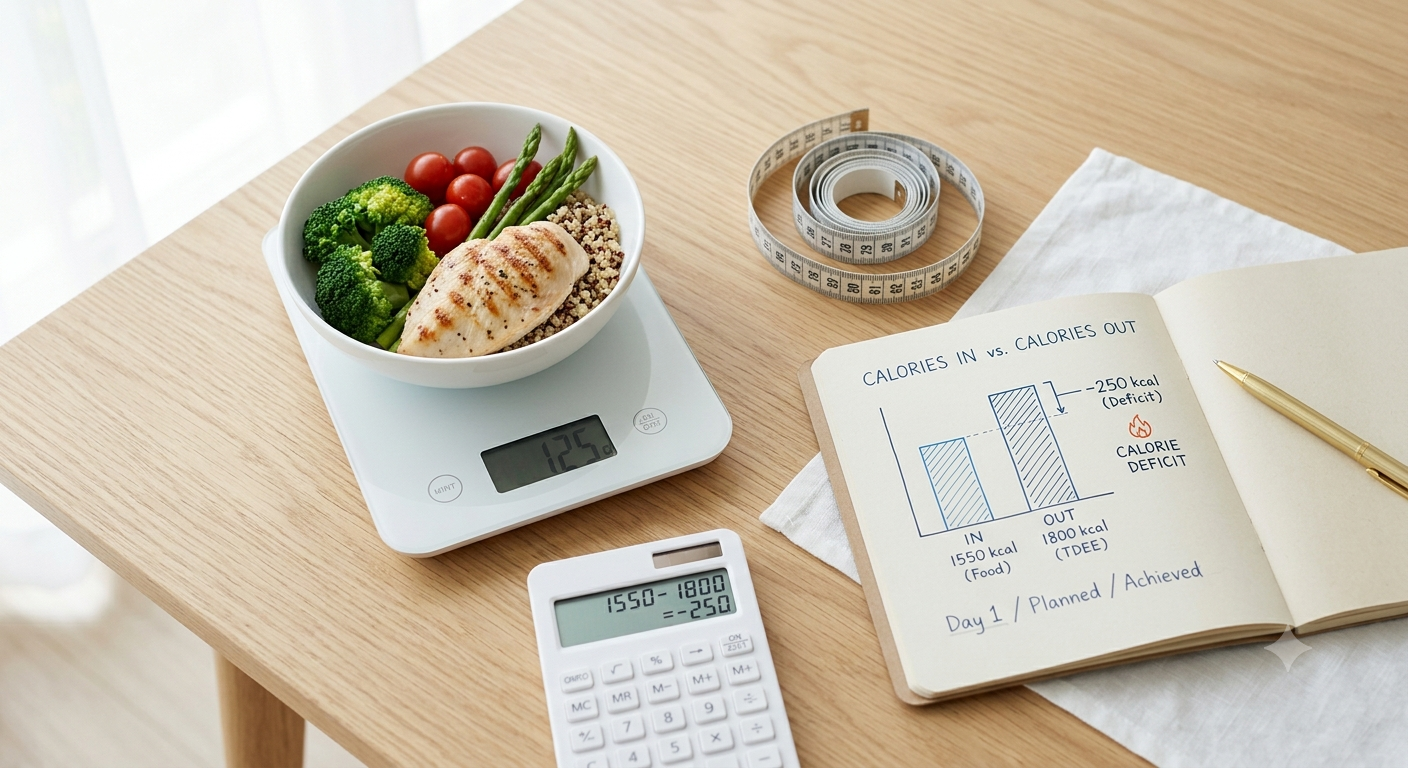
If you’ve spent any time researching weight loss, you’ve probably come across the term “calorie deficit” more times than you can count. It’s the foundation of almost every successful weight loss story — yet many beginners still don’t fully understand what it means or how to apply it correctly.
In this guide, we’ll break down exactly what a calorie deficit is, how it works inside your body, how to calculate one for yourself, and how to create it in a healthy, sustainable way — without starving yourself or burning out after two weeks.
Let’s get into it.
What Is a Calorie Deficit?
A calorie deficit happens when you consume fewer calories than your body burns in a day. Since your body needs energy (calories) to function, move, and maintain itself, eating less than it needs forces it to tap into stored energy — primarily body fat — to make up the difference.
In simple terms:
- Calories in < Calories out = Calorie deficit = Weight loss
- Calories in > Calories out = Calorie surplus = Weight gain
- Calories in = Calories out = Maintenance = Stable weight
This is the core principle behind nearly every weight loss method, regardless of whether it’s keto, intermittent fasting, or a balanced macro-based diet. All of them work — when they do — because they ultimately create a calorie deficit.
How Does a Calorie Deficit Actually Work?
Your body needs a certain number of calories each day just to keep your heart beating, lungs breathing, and cells functioning — this is called your Basal Metabolic Rate (BMR). On top of that, your daily activities, exercise, and digestion burn additional calories, giving you your Total Daily Energy Expenditure (TDEE).
When you eat fewer calories than your TDEE, your body has to find energy from somewhere else. It turns to stored fat (and sometimes muscle, if the deficit is too extreme or protein intake is too low) to cover the gap. Over time, this stored energy loss shows up as weight loss on the scale.
How to Calculate Your Calorie Deficit
Calculating your personal calorie deficit involves a few simple steps.
Step 1: Find Your BMR
Your BMR can be estimated using formulas like the Mifflin-St Jeor equation, which factors in your age, weight, height, and gender. Many free online calculators can do this instantly.
Step 2: Calculate Your TDEE
Multiply your BMR by an activity factor based on your lifestyle:
- Sedentary (little to no exercise): BMR × 1.2
- Lightly active (light exercise 1–3 days/week): BMR × 1.375
- Moderately active (moderate exercise 3–5 days/week): BMR × 1.55
- Very active (hard exercise 6–7 days/week): BMR × 1.725
- Extremely active (physical job + training): BMR × 1.9
Step 3: Create Your Deficit
Once you know your TDEE, subtract 300–500 calories to create a moderate, sustainable deficit. For example, if your TDEE is 2,200 calories, eating around 1,700–1,900 calories daily would put you in a healthy deficit for gradual fat loss.
How Big Should Your Calorie Deficit Be?
Not all deficits are created equal. Going too extreme can backfire, while too small a deficit may show slow or unnoticeable results.
- Small deficit (100–250 calories): Very gradual weight loss, easier to sustain, ideal for beginners or those close to their goal weight.
- Moderate deficit (300–500 calories): The most commonly recommended range — roughly 0.5–1 pound of fat loss per week.
- Aggressive deficit (500–1000 calories): Faster results but higher risk of muscle loss, fatigue, and nutrient deficiencies if not carefully managed.
As a general rule, avoid dropping below 1,200 calories per day (for most adults) without medical supervision, as this can slow metabolism and cause nutrient deficiencies.
Signs You’re in a Healthy Calorie Deficit
A well-managed calorie deficit shouldn’t leave you feeling miserable. Signs you’re doing it right include:
- Steady, gradual weight loss (0.5–1 kg or 1–2 lbs per week)
- Stable energy levels throughout the day
- Minimal muscle loss (especially if you’re strength training)
- No extreme hunger or constant food obsession
- Consistent sleep and mood stability
If you’re experiencing dizziness, constant fatigue, hair loss, or irregular periods (in women), your deficit may be too aggressive and should be adjusted.
How to Create a Calorie Deficit Without Starving Yourself
A calorie deficit doesn’t have to mean feeling hungry all the time. Here’s how to make it sustainable.
1. Prioritize Protein
Protein keeps you fuller for longer and helps preserve muscle mass during weight loss. Aim for lean meats, eggs, fish, legumes, and dairy in every meal.
2. Eat High-Volume, Low-Calorie Foods
Vegetables, fruits, and high-fiber foods take up more space in your stomach for fewer calories, helping you feel satisfied without overeating.
3. Avoid Liquid Calories
Sugary drinks, juices, and alcohol add up quickly without providing satiety. Cutting these is one of the easiest ways to reduce daily calorie intake.
4. Track Your Food Intake
Using an app to log meals — even for a few weeks — helps you understand portion sizes and identify hidden calorie sources you might be missing.
5. Don’t Eliminate Entire Food Groups
Restricting entire food groups often leads to cravings and binge eating. Instead, focus on portion control and balance.
6. Combine Diet with Movement
Rather than cutting calories excessively, add light activity like walking or strength training to increase your TDEE — giving you more flexibility with food while maintaining your deficit.
Common Calorie Deficit Mistakes to Avoid
Even with the right intentions, beginners often make mistakes that slow their progress.
- Underestimating portion sizes — leading to accidental overeating
- Overestimating exercise calories burned — fitness trackers often overestimate calorie burn
- Cutting calories too drastically — leading to binge eating or metabolic slowdown
- Ignoring protein intake — resulting in muscle loss instead of fat loss
- Not accounting for weekends — where extra snacks, drinks, or dining out can offset an entire week’s deficit
- Expecting linear weight loss — natural fluctuations from water retention, hormones, and digestion are completely normal
Calorie Deficit vs. Other Weight Loss Approaches
Many diet trends — keto, intermittent fasting, low-carb, plant-based — all work through the same underlying mechanism: creating a calorie deficit, whether directly or indirectly.
- Intermittent fasting reduces the eating window, often naturally lowering calorie intake.
- Keto diets reduce appetite through higher fat and protein intake, indirectly creating a deficit.
- Low-carb diets often reduce overall calorie intake by cutting processed, calorie-dense carbs.
Understanding this helps explain why any diet can work for weight loss — as long as it results in a consistent calorie deficit that you can actually stick to.
How Long Does It Take to See Results?
Most people begin noticing changes within 2–4 weeks of consistently maintaining a calorie deficit, though visible fat loss can vary based on starting body composition, hormones, and consistency. Weight loss is rarely linear — expect natural fluctuations from water weight, sodium intake, and hormonal cycles.
Quick Recap: Key Calorie Deficit Takeaways
- A calorie deficit means eating fewer calories than your body burns (TDEE)
- Calculate your BMR and TDEE to personalize your deficit
- A moderate deficit of 300–500 calories is ideal for most people
- Prioritize protein and fiber to stay full while in a deficit
- Avoid extreme calorie cuts to prevent muscle loss and metabolic slowdown
- Combine diet with movement for more sustainable, flexible results
- Track progress over weeks, not days, since weight naturally fluctuates
Frequently Asked Questions About Calorie Deficit
Q1: How many calories should I cut to lose 1 pound a week? Roughly 3,500 calories equal one pound of fat, so a daily deficit of about 500 calories typically leads to about 1 pound of weight loss per week.
Q2: Can I be in a calorie deficit and still gain muscle? Yes, especially for beginners or those returning to strength training — this is often called “body recomposition” — though muscle gain is usually slower compared to eating at maintenance or a surplus.
Q3: Is it bad to be in a calorie deficit every day? Extended deficits without breaks can lead to metabolic adaptation and fatigue. Many people benefit from periodic “maintenance breaks” or diet breaks every 8–12 weeks.
Q4: Do I need to count calories forever to maintain weight loss? No. Many people transition to intuitive eating or portion-based guidelines once they understand their calorie needs and have built sustainable habits.
Q5: Why am I in a calorie deficit but not losing weight? Common reasons include inaccurate calorie tracking, underestimated portion sizes, water retention, hormonal factors, or an overestimated TDEE. Reassessing your intake after 2–3 weeks usually clarifies the issue.
Final Thoughts
A calorie deficit is the foundation of weight loss — but how you create that deficit determines whether it’s sustainable or short-lived. By calculating your TDEE, choosing a moderate deficit, prioritizing protein and fiber, and avoiding common mistakes, you can lose fat steadily without feeling deprived. For more evidence-based articles on nutrition, fitness, and healthy living, visit Health and Fitness Club.