




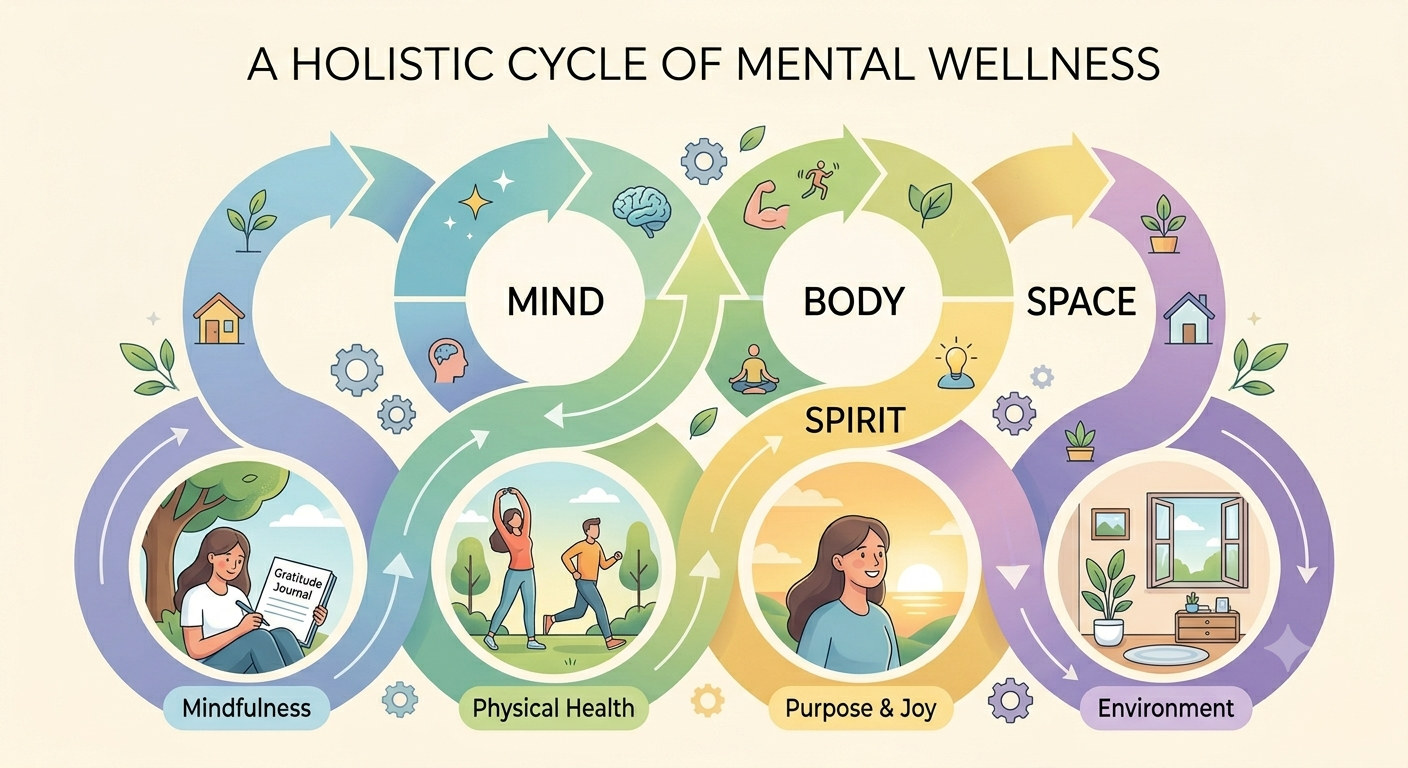
In the fast-paced landscape of the 21st century, where the “always-on” culture is the norm, the concept of mental wellness has evolved from a luxury to an absolute survival necessity. We are witnessing a societal awakening where individuals are realizing that true success is unattainable without a stable, resilient emotional foundation. This comprehensive master guide dives deep into the science of self-care, providing you with actionable, expert-backed strategies to cultivate emotional resilience, optimize your cognitive health, and reclaim your peace in an increasingly chaotic world.
The Physiology of Self-Care
Self-care is often misunderstood as “pampering.” In reality, it is a biological imperative. To understand this, we must look at how the body manages stress.
Nervous System Regulation
Your mental health is a mirror of your nervous system’s state. When you are perpetually in a “fight-or-flight” (sympathetic) mode, your body floods with cortisol, which over time, impairs your executive function. The goal of advanced self-care strategies is not to eliminate all stress, but to improve your “vagal tone”—your ability to recover quickly from stress.
Practical Grounding Techniques
To shift from a stressed state to a calm state, grounding mindfulness exercises are your primary tool. These exercises are not just “new age” concepts; they are neuro-biological interventions. By focusing on sensory input, you interrupt the amygdala’s fear response.
The Five Senses Mindfulness Exercise: This is the gold standard for immediate anxiety reduction. By forcing your brain to process external stimuli (5 things you see, 4 you touch, etc.), you halt the internal loop of ruminating thoughts.
The Cognitive Toolkit for Mental Clarity
Maintaining mental wellness requires proactive cognitive hygiene. Just as you brush your teeth to prevent decay, you must perform cognitive maintenance to prevent emotional stagnation.
Subconscious Mind Exercises
Many of our self-sabotaging behaviors (like procrastination, emotional eating, or negative self-talk) are rooted in the subconscious. Utilizing subconscious mind exercises—such as morning scripting, cognitive reframing, or structured journaling—allows you to bring these hidden patterns to light. Once a subconscious belief is brought into the conscious mind, it loses its power to control your reactions.
Evidence-Based Breathing
The breath is the only part of your autonomic nervous system that you can consciously control. Whether you are using a mindfulness breathing exercise pdf from a clinical source or practicing rhythmic box breathing, the goal is to lengthen your exhales. Longer exhales stimulate the vagus nerve, which tells your brain that it is safe to down-regulate from a stress response.
Social & Group-Based Wellness
We are social creatures, and our mental health is heavily influenced by the quality of our connections.
The Power of Community
Isolation is the enemy of mental health. Engaging in group mindfulness exercises provides two critical benefits: social connection and external accountability.
DBT Mindfulness Exercises for Groups: Dialectical Behavior Therapy (DBT) is designed to help individuals with emotional dysregulation. Even for those without clinical diagnoses, dbt mindfulness exercises for groups offer powerful frameworks for interpersonal effectiveness, distress tolerance, and emotional regulation.
Shared Practice: When you participate in group mindfulness exercises, the collective focus of the group can actually make it easier for you to enter a meditative state, as the “social energy” helps anchor your attention.
Advanced Behavioral Frameworks
To elevate your self-care to an expert level, you must integrate psychological frameworks that guide your daily behavior.
ACT (Acceptance and Commitment Therapy)
The core of modern wellness is not about “feeling happy” 24/7; it is about feeling “whole.” Act mindfulness exercises teach you to accept difficult emotions—like sadness, frustration, or anxiety—as temporary data points rather than permanent truths. When you stop fighting your emotions, you spend less energy suppressing them, which leaves you with more mental bandwidth for your goals.
Intentional Screen Time Management
Your digital environment is an extension of your mental space. Expert-level self-care involves strict screen time management. This includes:
The Digital Curfew: Absolutely no screens 90 minutes before bed.
The Notification Audit: If it doesn’t involve a human being you care about, it doesn’t deserve a notification.
Analog Intermissions: Schedule 15 minutes of “no-tech” time every day where you focus purely on a physical activity or observation.
Frequently Asked Questions
Q1: What is the single most effective self-care strategy for a beginner?
A: Start with consistency over intensity. The five senses mindfulness exercise is the best starting point because it is portable, requires no equipment, and provides immediate physiological feedback.
Q2: How do I know if I’m practicing effective self-care or just avoiding responsibility?
A: True self-care enables you to meet your responsibilities with more energy. If your “self-care” (like doom-scrolling or excessive gaming) leaves you feeling drained or guilty, it’s not self-care—it’s avoidance.
Q3: Where can I find reliable instructions for breathing?
A: I recommend looking for a professionally curated mindfulness breathing exercise pdf. These documents often contain diagrams and specific timings (like the 4-7-8 ratio) that are scientifically verified.
Q4: Can I practice DBT exercises if I’m not in therapy?
A: Yes, many dbt mindfulness exercises for groups are available in public wellness resources and are excellent for building “distress tolerance” and “emotional regulation” skills.
Q5: What are the best subconscious mind exercises to improve productivity?
A: Visualization and “Future-Self Journaling” are excellent subconscious mind exercises. By clearly defining who you want to be, you rewire your brain to notice opportunities that align with that version of yourself.
Q6: Why are ACT mindfulness exercises better than just “positive thinking”?
A: Positive thinking is often just suppression. Act mindfulness exercises are about acceptance. When you accept reality, you don’t waste energy being angry at the world. This is the foundation of genuine resilience.
Q7: How can group mindfulness exercises help with social anxiety?
A: They provide a low-stakes environment to practice presence. By sharing the experience with others, you realize that your internal struggles are often universal, which significantly reduces the shame associated with mental health challenges.